Better Sleep for Baby and Mom
Find out what is really waking your baby, change only what needs changing, and teach a gentler way back to sleep only if you need it.
Free 18-page guide now · full 54-page guide with 7 printable worksheets coming soon
You are tired, and you have tried a lot.
Most sleep guides hand you one method. This one starts with a better question: what is actually waking your baby?
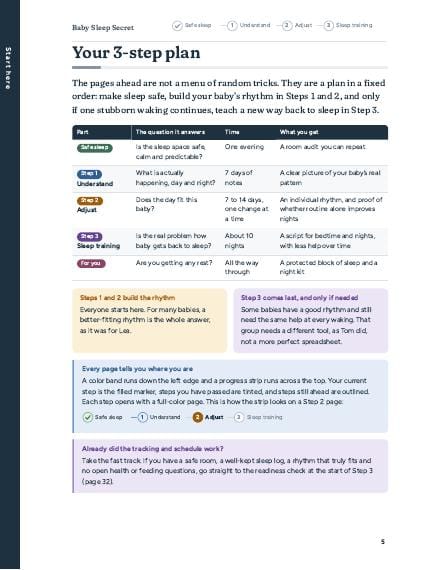
Three steps. Sleep training comes last.
Steps 1 and 2 build your baby’s rhythm, and for many babies that is the whole answer. Step 3 is only for the babies who still need it. Every page shows which step you are on, so you never lose your place at 3 a.m.
Understand
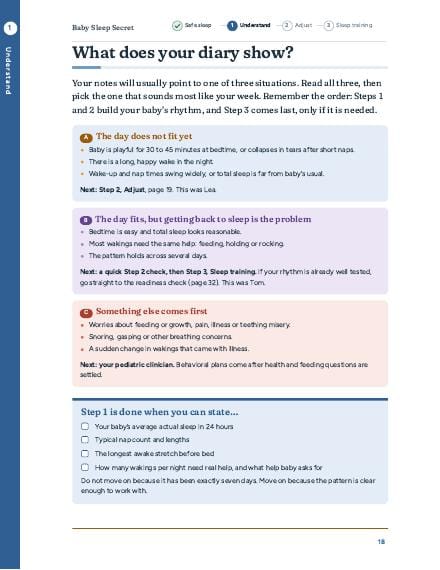
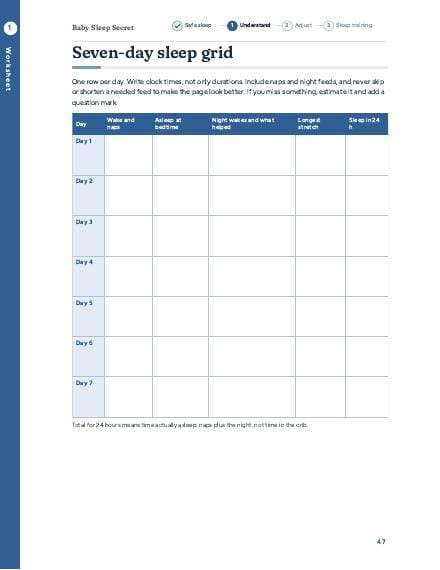
Keep a simple 7-day sleep diary and learn to read it. Is it the schedule, the way your baby falls asleep, or something to raise with your pediatrician?
Adjust
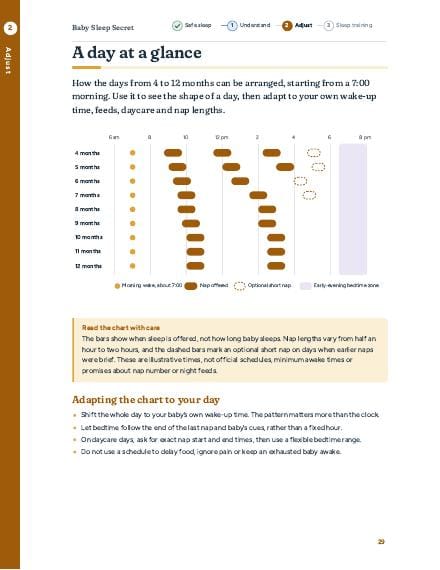
Change the day around the baby you actually have: naps, awake stretches, bedtime. One change at a time, so you can see what works.
Sleep training
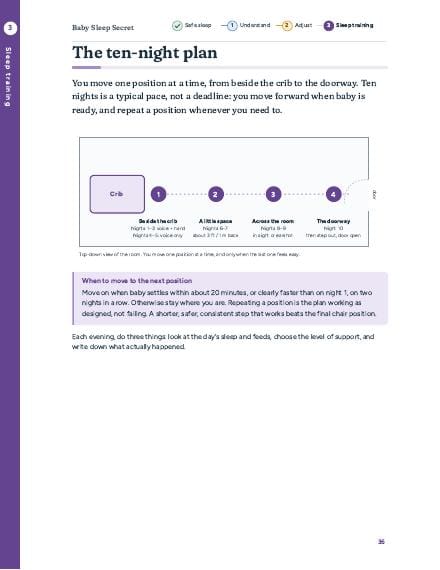
Only if repeated help at night is still the problem. A gentle, parent-present plan: the chair method, night by night over about ten nights.
Two children, two different fixes.
Both went from terrible sleepers to rock stars. They have very different temperaments, which is why this guide has three steps instead of one method.
Tom
Bedtime was easy. But every waking needed nursing, up to ten times a night. His schedule was already fine. What changed his nights was how he got back to sleep.
Steps 1 to 3 · The full planLea
Her sleep looked just as chaotic, even when the routine looked perfect on paper. When I stopped chasing a textbook schedule and followed her real pattern, her nights became much easier.
Steps 1 and 2 · Her rhythm was enoughA real working guide, not a pile of tips.
54 pages, color-coded by step, with worksheets you can print and fill in.
- Safe sleep checklist, the bare crib and the sleep-friendly room
- 7-day diary and how to read it like a detective
- “What does your diary show?” Your next step on one page
- Month-by-month guide for 4 to 12 months
- Light, awake stretches, feeds, play and screens
- A wind-down routine in three lengths
- A ten-night plan with the exact words and rules
- Night wakings, early mornings and naps
- A page for you, with a night kit
- Six sleep myths, checked
- Troubleshooting for ten hard moments
- Seven printable worksheets

Start tonight with The Sleep-Friendly Night.
An 18-page visual guide to baby sleep hygiene: six habits that make good sleep easier, and the foundation of the full method.
- A safe sleep checklist and the sleep-friendly room
- Light, rhythm and a wind-down routine for babies 4 to 12 months
- A 7-night checklist and a notice sheet to print
Made for the months when sleep gets hard.
This guide is for you if
- your baby is 4 to 12 months old
- you want to understand the cause before changing the routine
- you would rather stay beside your baby than leave them to cry alone
- you want a plan you can follow while tired
Not yet, or ask your pediatrician first
- Your baby is under 4 months. Step 3 is written for babies from 6 months (5 only with your pediatrician's agreement).
- You suspect a medical problem, such as breathing trouble, poor feeding or growth, or pain. The guide tells you which signs to raise first.
Better Sleep for Baby and Mom
- 54-page guide, easy to read on a phone
- All three steps and the ten-night plan
- Seven printable worksheets
- Safe sleep checklist, a page for you, and troubleshooting
The full guide will be available soon. The free guide is a good first step, and it is yours to keep.
Good to know
Do I have to sleep train?
No. Steps 1 and 2 come first, and for many families Step 2 is the whole answer. Step 3 is there if repeated help at night is still the problem.
Is this cry-it-out?
No. It is a gradual, parent-present approach: you stay close and reduce your help in small, planned steps. Your baby may protest while learning something new. The guide shows you how to tell protest from real distress, and when to pause.
Will it work for my baby?
No guide can promise a result. Studies of behavioral sleep methods find lasting improvement in most children treated, and the guide shows you exactly what to check if progress stalls.
What age is it for?
Steps 1 and 2 are written for babies from 4 months. Step 3 is written for babies from 6 months, and for 5 months only with your pediatrician's agreement.
Is it safe?
The guide starts with a safe sleep checklist based on American Academy of Pediatrics guidance. It is educational, not medical advice, and it tells you when to talk to your pediatric clinician first.
Who wrote it?
I am a mother of two. I am not a doctor or a certified sleep consultant. The stories are real, the guide draws on published research and standard safe sleep guidance, and the sources are listed at the end.
How do I get the guide?
The free guide arrives by email after you confirm your address. The full guide is coming soon, and I will email you when it is ready.
Imprint
Baby Sleep Secret (babysleep-secret.com) is operated by:
Svetlana Rodionova
Pärnu mnt 100–12
11312 Tallinn
Estonia
Email: hello@babysleep-secret.com
The information on this website is general educational information about infant sleep. It does not replace the advice of a pediatrician or other health professional. If you have concerns about your baby's health, talk to your pediatric clinician.
Back to the topPrivacy policy
Last updated: 24 November 2026
1. Who is responsible
Svetlana Rodionova, Pärnu mnt 100–12, 11312 Tallinn, Estonia. Email: hello@babysleep-secret.com. This is the operator of Baby Sleep Secret (babysleep-secret.com).
2. What data we process, why, and on what legal basis
Visiting this website. The platform that hosts this page (see section 3) processes the technical data every web server needs to deliver a page: IP address, date and time, requested page and browser type. It also uses technical services such as error monitoring to keep the pages running. Legal basis: Art. 6(1)(f) GDPR (a secure, working website). This page does not use analytics, advertising pixels or social media plugins.
Free guide sign-up. When you enter your email address to get the free guide, we use it to send you a confirmation email, the guide, and occasional emails about baby sleep, including a note when the full guide is available. We store your email address, the time and IP address of your sign-up and of your confirmation (double opt-in), and your subscription status. Legal basis: your consent, Art. 6(1)(a) GDPR. You can withdraw your consent at any time with the unsubscribe link in every email or by writing to us. This does not affect what was done before.
Email statistics. Our email tool may record whether an email was opened and which links were clicked, so that we can see which content is useful. Legal basis: your consent given at sign-up, Art. 6(1)(a) GDPR.
Contact by email. If you write to us, we use your email address and your message to answer you. Legal basis: Art. 6(1)(b) or (f) GDPR.
3. Service providers who process data for us
- systeme.io, operated by ITACWT Limited, 2 Cruise Park Rise, Tyrrelstown, Dublin 15, Ireland: website, sign-up form and email sending. According to the provider, data is hosted on Amazon Web Services servers in Ireland.
- GoDaddy: domain registration and DNS (the domain name, not your sign-up data).
- Forward Email (forwardemail.net): forwards emails sent to our contact address to our mailbox.
- Google (Gmail): our mailbox, where emails you send to us arrive.
Some of these providers are based outside the EU. Where data is transferred to such countries, we rely on the safeguards required by the GDPR, such as the EU-US Data Privacy Framework or standard contractual clauses.
4. How long we keep data
Sign-up data is kept until you unsubscribe or ask us to delete it. After that we may keep a minimal record (email address and proof of consent) only as long as needed to prove the consent given or to defend legal claims (Art. 6(1)(f) GDPR). Emails you send us are deleted when the matter is closed, unless a legal retention duty applies.
5. Your rights
You have the right to access, correction, deletion, restriction of processing and data portability, the right to object to processing based on legitimate interests (Art. 15 to 21 GDPR), and the right to withdraw consent at any time. Write to hello@babysleep-secret.com.
You can also complain to a supervisory authority, for example the Estonian Data Protection Inspectorate (Andmekaitse Inspektsioon), Tatari 39, 10134 Tallinn, Estonia, info@aki.ee, www.aki.ee, or the authority in the country where you live.
6. Children
This website is for parents and caregivers. It is not directed at children.
7. Changes
We update this policy when the website or the legal situation changes. The current version is always on this page.
Back to the top